the June 11 dinner report
A Gentleman in MoscowThe June 11 dinner report is Count Alexander Ilyich Rostov’s covert record of a dinner that doubled as a display of political power. Its diagram and detailed account turn the seating, timing, and apparently casual exchanges of the June 11, 1954 gathering into evidence of political alignment; hidden in a shoulder strap, the report becomes part of the practical chain that can confirm Sofia’s safe arrival at the American embassy.
Concealment and Recovery
While alone, Richard Vanderwhile used a penknife to open the carefully sewn seam along the top of a shoulder strap. Inside the narrow channel behind it, he found a tightly rolled piece of paper. The concealment made the report portable and difficult to notice among the clothes Richard had been asked to show Sofia.
After reading the report, Richard noticed a second, slightly curled piece of paper on his desk. It had presumably been rolled up with the account. The accompanying note gave a straightforward instruction for confirming that Sofia had arrived safely at the embassy, followed by a long sequence of seven-digit numbers. Richard recognized the Count’s handwriting and jumped to his feet. The report thus serves not only as an account of political maneuvering but as the container for a message with an immediate practical purpose.
Design and Contents
The report’s top side carried a diagram titled “Combined Dinner of Council of Ministers and Presidium, June 11, 1954.” It represented the table as a long U, with the names of all forty-six attendees arranged around its perimeter. Beneath each name appeared the person’s title and a three-word summation of his personality. On the reverse was a detailed description of the dinner.
The report recorded the announcement concerning the Obninsk nuclear power plant and its theatrical connection to the Moscow grid, but its emphasis was on the evening’s social nuances. That distinction reflects the Count’s method: the public announcement mattered, yet who knew the venue, who approached whom, and how the guests took their places revealed the political work taking place beneath the official celebration.
The Dinner as Political Evidence
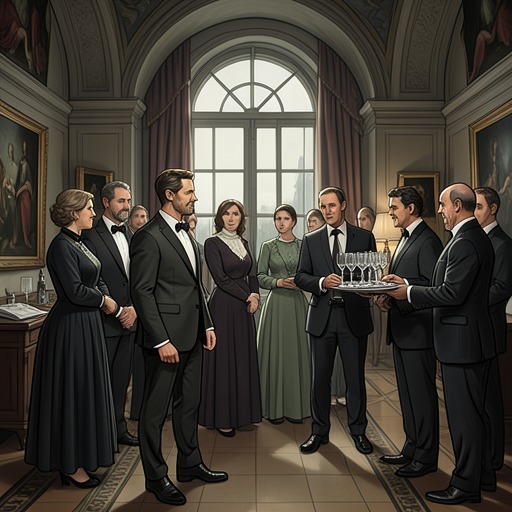
The report noted that nearly all the guests appeared to expect a formal dining room in the Boyarsky restaurant and were surprised to be directed instead to suite 417. Nikita Khrushchev was the exception. He entered with the composure of someone who knew where the dinner would be held and was satisfied with its arrangement. His later toast, which referred to a historic event in the suite two floors below, further indicated his involvement in the evening’s planning.
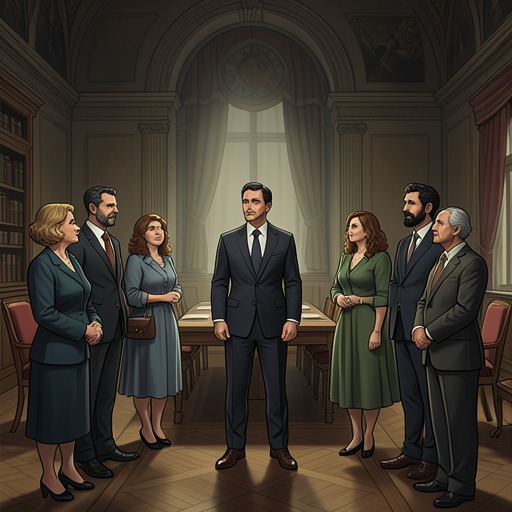
The seating diagram captured a hierarchy that required little visible direction. At precisely 9:00 p.m., the doors opened; by 9:15, all forty-six men had taken places appropriate to their rank. Bulganin, Khrushchev, Malenkov, Mikoyan, Molotov, and Voroshilov occupied the head of the table, with the central seats reserved for Premier Malenkov and General Secretary Khrushchev. Khrushchev did not immediately make for the head of the table. He first spoke with Malyshev, the Minister of Medium Machine Building, then took the last empty seat beside Malenkov only after the other guests had settled.
The Count interpreted the exchange as a carefully staged political gesture. Malenkov had opposed Khrushchev on nuclear armament, describing an arms race with the West as an apocalyptic policy. The evening instead joined the prospect of nuclear power to the sight of Moscow lit by its connection to the grid. In the Count’s reading, Khrushchev’s alignment with Malyshev allowed him to appear as an advocate of the future while making his rival look reactionary. When Malyshev later crossed the room to confer with Khrushchev and took the empty chair at his side, Malenkov was left awkwardly waiting behind them before he could reclaim his place. The report preserves that small, visible displacement as part of the evening’s larger political maneuver.
Observation Made Actionable
The account depends on distinctions that a less attentive observer might have missed: surprise at the venue, the sequence in which men approached the table, the choice of seats, and the timing of a toast. Its diagram reduces the gathering to names, ranks, and character summaries; its reverse restores the movements and interactions that gave those positions meaning. Together, the two sides make the dinner legible as both a formal event and a performance of authority.
The recovered note extends that observational record into action. Richard’s recognition of the Count’s handwriting links the detailed report to the instruction about Sofia, while the seven-digit sequence supplies information needed for the safety check. What might have looked like a piece of political documentation therefore carries a personal message as well: the report makes the Count’s analysis readable, and its concealed companion gives Richard a way to establish whether Sofia has reached safety.